Myung J. Lee
Professor
Building
Steinman Hall
Office
ST 677
Phone
(212) 650-7260
Fax
(212) 650-8249
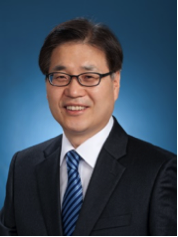
Myung J. Lee
Profile
Dr. Myung J. Lee received a B.S and an MS from Seoul National University in Korea and Ph.D degree from Columbia University in electrical/electronics engineering. He is currently a professor at the Dept of Electrical & Computer Engineering and a doctoral faculty of computer science at Graduate Center of City University of New York. He is also an adjunct professor at GIST.
Dr. Lee’s recent research interests include AI/machine learning for communications and networks such as resource management for wireless systems and mobile edge cloud computing network, stochastic computing applications for deep neural networks, intrusion detection system, secure V2X communications, and COSMOS wireless testbed beyond 5G. His researches have been funded by government agencies and leading industries, including, NSF, ARL, Bellcore, Samsung and ETRI. He published extensively in those research areas more than 200 journal and conference papers, book chapters, and more than 25 U.S. and international patents, and numerous international standard contributions including IEEE 802.15 standards (chair for TG5 WPAN Mesh and TG8 Peer Aware Communications) and ZigBee. Dr. Lee’s research group developed the first NS-2 simulator for IEEE 802.15.4, a standard NS-2 distribution widely used for wireless sensor network researches. He co-received the three best paper awards and CUNY Performance Excellence Award.
Education
Ph.D., Electrical Engineering, Columbia University, New York, 1990
M.S., Electrical Engineering, Seoul National University, Korea, 1978
B.S., Electrical Engineering, Seoul National University, Korea, 1976
Courses Taught
5G Mobile Communication & IoT
Wireless Communications
Probability and Random Processes
Wireless sensor/ad hoc networks
Advanced wireless multimedia networks
Senior Design
Research Interests
Dr. Lee’s current research interests include Machine Learning based management of resources for mobile edge cloud and IoT, wireless communications, Secure V2X group communications, stochastic computing based Deep Neural Net and Intrusion Detection System, and NSF COSMOS wireless testbed for future wireless communications.
Recent projects:
- AI/ML-enabled Distributed Strategic Board Games on A Global Testbed
This international collaboration among CCNY, GIST and AFRL advances wargaming by integrating AI/ML for real-time, global experimentation. The project develops an LLM- and DRL-based adaptive AI opponent for strategic war board games, enhancing realism and training value. It also builds a robust, secure multiplayer networking solution—leveraging ML for delay/jitter/loss mitigation and using IPSec/GRE tunnels over the NSF COSMIC testbed—to support reliable international gameplay and collaboration.
- Digital Twin-Enabled Semantic-Adaptive Network Management for Real-Time Strategic Games
This project proposes a Digital Twin (DT)–enabled, semantic-adaptive network management framework for real-time strategic wargaming in bandwidth-limited and contested networks. To prevent DT desynchronization under network degradation, the framework prioritizes meaning-level communication over raw data exchange. It integrates LoRA-augmented foundation model–based semantic encoding, a DT-aware DRL encoder selector, and RL-based bandwidth allocation on P4-programmable switches. The system dynamically adapts encoding and bandwidth based on semantic importance, network conditions, and DT coherence needs, improving resilience and efficiency. Validation will be conducted via simulation and deployment on the NSF COSMIC testbed.
- NSF IRNC: Testbed COSMOS Interconnecting Continents (COSMIC)
A Rutgers/Columbia/Arizona/CCNY team has been awarded from NSF entitled "IRNC: Testbed: COSMOS Interconnecting Continents (COSM-IC)". The project is aimed at development of an international networking and wireless testbed by federating US research testbeds including COSMOS, ORBIT, FABRIC and PEERING with experimental facilities in Ireland, Greece, Brazil and Japan. The federated international testbed will enable experimental research on a wide range of optical, wireless, SDN networking, inter-domain routing and edge computing experiments at a global scale. In particular, CCNY and Kyutech Japan have been collaborating for a set of experiments using COSM-IC fiber connectivity.
- NSF PAWR: COSMOS testbed (Cloud Enhanced Open Software Defined Mobile Wireless Testbed for City-Scale Deployment)
The COSMOS testbed will cover one square mile in West Harlem, with City College to the north, Columbia University’s Morningside Heights campus to the south, the Hudson River to the west, and Apollo Theater to the east. This vibrant, densely populated neighborhood is seen as an ideal place to push the bandwidth and latency limits of 4G, and even fifth-generation wireless technology, or 5G, which carriers are starting to roll out in some cities now.
The COSMOS architecture has a particular focus on ultra-high bandwidth and low latency wireless communication tightly coupled with edge cloud computing. The COSMOS testbed will be deployed in upper Manhattan and will consist of 40-50 advanced software-defined radio nodes along with fiber-optic front-haul and back-haul networks and edge and core cloud computing infrastructure. Researchers will be able to run experiments remotely on the COSMOS testbed by logging into a web-based portal which will provide various facilities for experiment execution, measurements, and data collection.
- NSF JUNO2: Resilient Cloud Designed Networks (RECN)
The objective of this joint research between CUNY and Kyutech Japan is to conduct between foundational research on a resilient edge cloud designed network to achieve basic understanding of the underlying science for future RECN. This work will cover issues of security, heterogeneity, resource constraints and potential mobility of end devices/sensors. A backbone network will be implemented and diversity of access network technologies, availability/placement of computing resources and Quality of Service (QoS) requirements will be examined.
Publications (Selected)
• Muhammad Irfan, Hang Hu, Myung Lee, Arslan Qadeer Yang Kim, Kazi Ahmed, Daiki Nobayashi, “Flow-level Bandwidth Allocatioin on P4 Tofino Switch with In-Network DRL Inference, IEEE ICAIIC2025, Feb. 2025
• K. Ahmed, Myung Lee, Hang Hu, Muhammad Irfan, Yang Kim, “High Accuracy Training of Stochastic Computing-Based Host Intrusion Detection System for Smart Resource-Constrained-IoT,” 22nd International Conference on Mobile Systsems and Pervasive Computing (MobiSPC2025), August 4-6, 2025, Leuven, Belgium.
• Hang Hu, Marco Hernandez, Kazi Ahmed, Yang Kim, Myung Lee, Kazuya Tsukamoto, “DDPG-based Wireless Resource Allocation for Secure Time-Constrained Applications,” IEEE WCNC 2024, Dubai, UAE, April 2024
• Shota Akiyoshi, Yuzo Taeknaka, Kazuya Tsukamoto, Myung Lee, “Content search method utilizing the metadata matching characteristics of both Spatio-temporal content and user request in the IoT era”, IEICE Transaction on Communication, 2023Vol.E107-B,No.1, Jan. 2024.
• Arslan Qadeer, Myung Lee, Daiki Nobayashi, “P4-based In-Network RL inference for Efficient Flow-Level Bandwidth Allocation,” IEEE Globecom 2023
• Shota Akiyoshi, Yuzo Taeknaka, Kazuya Tsukamoto, Myung Lee, “Content search method utilizing the metadata matching characteristics of both Spatio-temporal content and user request in the IoT era”, IEICE Transaction on Communication, Aug. 2023
• Arslan Qadeer and Myung Lee, “Deep-Deterministic Policy Gradient based Multi-Resource Allocation in Edge-Cloud System: A distributed approach,” IEEE Access, Vol. 11, Jan. 2023, pp. 20381-20398, Digital Object Identifier: 10.1109/ACCESS.2023.3249153
• Hotaka Kaneyasu, Daiki Nobayashi, Kazuya Tsukamoto, Takeshi Ikenaga, Myung Lee, “Complementary Data Transmission Control with Collision Avoidance for Efficient Retention of Large-size Spatio-temporal Data”, IEEE CCNC 2023
• Tingjun Chen, et. al, “Open-Access Millimeter-Wave Software-Defined Radios in the PAWR COSMOS Testbed: Design, Deployment, and Experimentation,” Computer Networks, (COMMNET-D-23-00990), co-author: Prasanthi Maddala, Panagiotis Skrimponis, Jakub Kolodziejski, Abhishek Adhikari, Hang Hu, Zhihui Gao, Arun Paidimarri, Alberto Valdes-Garcia, Myung Lee, Sundeep Rangan, Gil Zussman, Ivan Seskar, Accepted July 2023.
• A. Qadeer, M. Lee, K. Tsukamoto, “Flow-level Dynamic Bandwidth Allocation in SDN-enabled Edge Cloud using Heuristic Reinforcement Learning,” 8th IEEE Conference, on Future Internet of Things and Cloud, August, 2021
• Shumpei Shimokawa, Yuzo Taeknak, Kazuya Tsukamoto, Myung Lee, “SDN based in-network two-staged video QoE estimation with measurement error correction for edge network,” IEEE Access Journal, Vol. 9, Feb, 23, 2021
• (Invited Paper) T. Saadawi, A. Kawaguchi, M. Lee, A. Mowshowitz, “ Secure Resilient Edge Cloud Designed Network”, Trans. IEICE, Vol. E103-B, No. 4, pp.291-301 April 2020
• Kazi Ahmed and Myung Lee, “Secure Resource Allocation for LTE-based V2X Service,” IEEE Transaction on Vehicular Technology, Vol. 67, No. 12, pp. 11324-1133, Dec. 2018
• Kazi Ahmed and Myung Lee, “Secure, LTE-based D2D for V2X Services,” IEEE IoT Journal, Vol. 5, No. 5, October, 2018, pp. 3724-3732
• (Best Paper) S. Yamasaki, T. Kanaoka, Y. Taenaka, K. Tsukamoto, M. Lee, “ SDN-based time-domain error correction for in-network video QoE estimation in wireless networks,” Proc. of INCoS-2019, Sept. 2019
• Kwang Myung Jeon, Chan Jun Chun, Hong Kook Kim, and Myung J. Lee, “User-Aware Audio Marker Using Low Frequency Ultrasonic Object Detection and Communication for Augmented Reality,” Journal of Applied Science, Appl. Sci. May 2019
• K. Ahmed, B. Yuan, M. Lee, “High Accuracy Stochastic Computing based FIR Filter Design,” ICASSP 2018, Canada 2018
• M. Hussain, W. Brandauer, Myung Lee, “Mobility-aware Vehicle-to-Grid (V2G) Optimization for Uniform Utilization in Smart Grid based Power Distribution Network,” Journal of Mobile Networks and Application (MONET), April, 2018
• M Hussain and M. Lee, “End-to-end Delay minimization in Multi-Channel, TDMA Wireless Sensor Networks by Particle Swarm Optimization,” IEEE ICACCE 2018 (IEEE International Conference on Advances in Computer and Communication Engineering), Paris, 2018
• Yanchen Liu and Myung Lee, Yangyang Zheng, “Multi-Resource Allocation for Cloudlet-Based Mobile Cloud Computing System,” IEEE Transaction on Mobile Computing, Vol. 15., No. 10, Oct. 2016
• K. Jeon, H. Kim, M. Lee, “Non-coherent Low-frequency Ultrasonic Communication System with Optimum Symbol Length,” International Journal of Distributed Sensor Networks, May 2016
• Y. Kim and M. Lee, “Scheduling Multi-channel and Multi-timeslot in Time Constrained Wireless Sensor Networks via Simulated Annealing and Particle Swarm Optimization,” IEEE Communications Magazine, Vol. 52. No. 1, January 2014.
• (Best Paper) M. Hussain and M. Lee, “Mobility Incorporated Vehicle-to-Grid (V2G) Optimization for Uniform Utilization in Smart Grid based Power Distribution Network,” 1st EAI International conference on Smart Grid Inspired Future Technologies, May 2016, Liverpool, UK