Colloquium: Why Housing Matters
New York, NY 10031
Colloquium: Why Housing Matters

Thursday, Nov 5, 2026
4:00 pm - 5:30 pm
Sciame Auditorium (Room 107)
141 Convent Avenue
New York, NY 10031
This in-person colloquium is part of the exhibition and event series celebrating 25 years of the CCCB (Centre de Cultura Contemporània de Barcelona) European Prize for Urban Public Space, "Design Matters: In Favor of Urban Public Space".
What defines “secure” housing today? Who has access to it, and who is left out? How do policies and markets shape these conditions? What role can design play in addressing displacement and affordability? And how might housing respond to climate realities while remaining equitable? What would it mean to treat housing as a right rather than a privilege? How can we imagine new models of living that support both individual dignity and collective well-being?
Introduction: Prof. Kaja Kuehl
Moderator: Prof. Laura Wainer
Panelists (15-minute presentations):
Jing Liu, Architect and Principal, SO-IL, New York
Cassim Shepard, Distinguished Lecturer, Spitzer School of Architecture
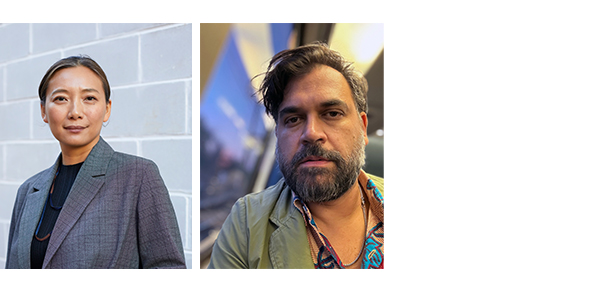 Panelists (left to right) Jing Liu, Cassim Shepard
Prof. Kaja Kuehl (she/her) is Founding Principal at youarethecity, a research and design practice based in Brooklyn, NY. Kaja has extensive architecture, urban design, and planning experience from large-scale urban systems and policies to civic engagement and circular material practices. Her current research and design work on designing with biobased materials has been published and exhibited widely and is subject to many of her courses. Kaja received a Diploma in Architecture from the Karlsruhe Institute of Technology, Germany and a M.S. in Urban Planning from Columbia University. She teaches seminars and design studios at Columbia University and the City College of New York in addition to frequent workshops in non-institutional settings.
Suggested Reading: Kuehl, Kaja, and Julie Behrens. “Spaces of Migration.” Architectural Design 88, no. 2 (2018): 86–93 and Kuehl, Kaja. “Housing as Carbon Storage.” In Atlas for Regenerative Construction in the American Northeast, 72–99. [New York]: youarethecity, 2025.
Prof. Laura Wainer (she/her) studies how housing policy and design shape social and political life. An Argentine architect and urban planner, she is Assistant Professor of Architecture and Urbanism at the Bernard & Anne Spitzer School of Architecture, CCNY. In her forthcoming book she argues that housing is where democracy is made material: in who gets to own, to stay, to decide. More than twenty years of applied design practice and collaborations with institutions such as the International Growth Centre at Oxford, Habitat for Humanity, and the Lincoln Institute of Land Policy taught her to translate in both directions: to bring field evidence into scholarship, and to make research legible to the people who actually build and govern cities. A Fulbright scholar, she holds a PhD from MIT.
Suggested Reading: Adler, Vanessa, and Tatiana Vera, eds. Housing: What's Next? From Thinking the Unit to Building the City. Washington, DC: Inter-American Development Bank, 2018 and Wainer, Laura Sara, Valeska Abarca, Lorraine Colbert, and Juan Jimenez Giraldo. Pathways to Home: Design Solutions for Immigrant-Centered Housing. New York: The Bernard and Anne Spitzer School of Architecture, The City College of New York, 2025 and Wainer, Laura Sara, and Billy Ndengeyingoma. Incremental Housing, and Other Design Principles for Low-Cost Housing. Project Report. London: International Growth Centre (IGC), November 2016 and Buckley, Robert M., Achilles Kallergis, and Laura Wainer. "The Emergence of Large-Scale Housing Programs: Beyond a Public Finance Perspective." Habitat International 54 (May 2016): 199–209.
Jing Liu (she/her) has been practicing for more than 15 years, working on a wide range of projects both in the US and abroad. Through building practice and interdisciplinary research projects, Liu has led SO–IL in the engagement with the socio-political issues of contemporary cities — in projects like the Artists Loft North Omaha and the Martin Luther King, Jr. Library in Cleveland. Her projects range from artistic collaborations with contemporary choreographers and visual artists to master plan and major public realm design in cities like Melbourne and Indianapolis. Liu brings an intellectually open, globally aware, and locally sensitive perspective to architecture. Her curiosity and artistic imagination allow her to bring a nuanced cultural perspective to the table. Her keen skills in combining digital technology with traditional craft and firm belief in design’s ability to re-engage people with the physical world around them allow the buildings she designs to become places of exchange that welcome interpretation and transformation.
Suggested Reading: SO–IL. In Depth: Urban Domesticities Today. New York: SO–IL, 2024.
Cassim Shepard (he/him) writes and makes films about cities, buildings and places. His film/video work has screened at the Venice Architecture Biennale, the Cooper Hewitt, the African Centre for Cities, and the United Nations, among other venues internationally. His writing on urbanism has appeared in Places, Next City, Domus, Public Culture, and more. He was founding editor-in-chief of Urban Omnibus, an online publication of The Architectural League of New York, which inspired his first book, Citymakers: the Culture and Craft of Practical Urbanism (Monacelli, 2017). His current book project — “Self-help Housing: Incremental Approaches to Shelter since 1965” — is supported by fellowships from the Guggenheim Foundation and MacDowell. Shepard directs the BA program in Urban Studies and the Built Environment at the Spitzer School of Architecture, City College, City University of New York.
Suggested Reading: Places Journal. "Housing Legacies of John Turner." Published November 1, 2024.
All colloquia are free, open to the public, and held in the Bernard and Anne Spitzer School of Architecture Sciame Auditorium. For live captioning, ASL interpretation, or access requests, please contact
Please Note: All public events must comply with the Public Event Code of Conduct