
Domain Decomposition Method for Coastal Ocean Flow


1. Coupling of SWM/FVCOM
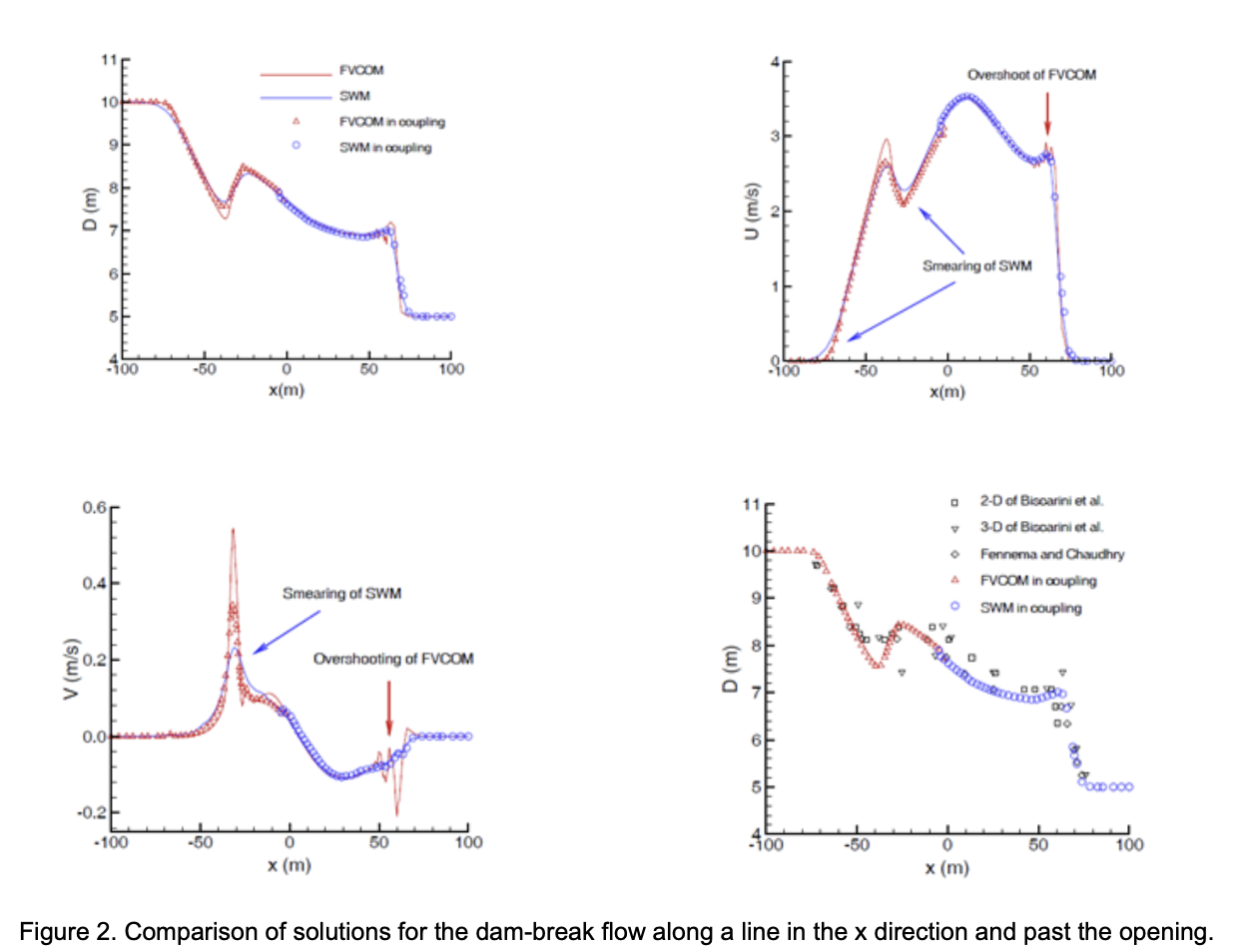
A shallow water model (SWM), which is based on the shallow water equations and a Godunov scheme, is coupled in two-way with FVCOM, a finite volume coastal ocean model. In the hybrid modeling system, FVCOM is used to capture large scheme background flows, the SWM is employed to resolve local phenomena such as flooding and surge bore.

2. Coupling of CFD/FVCOM
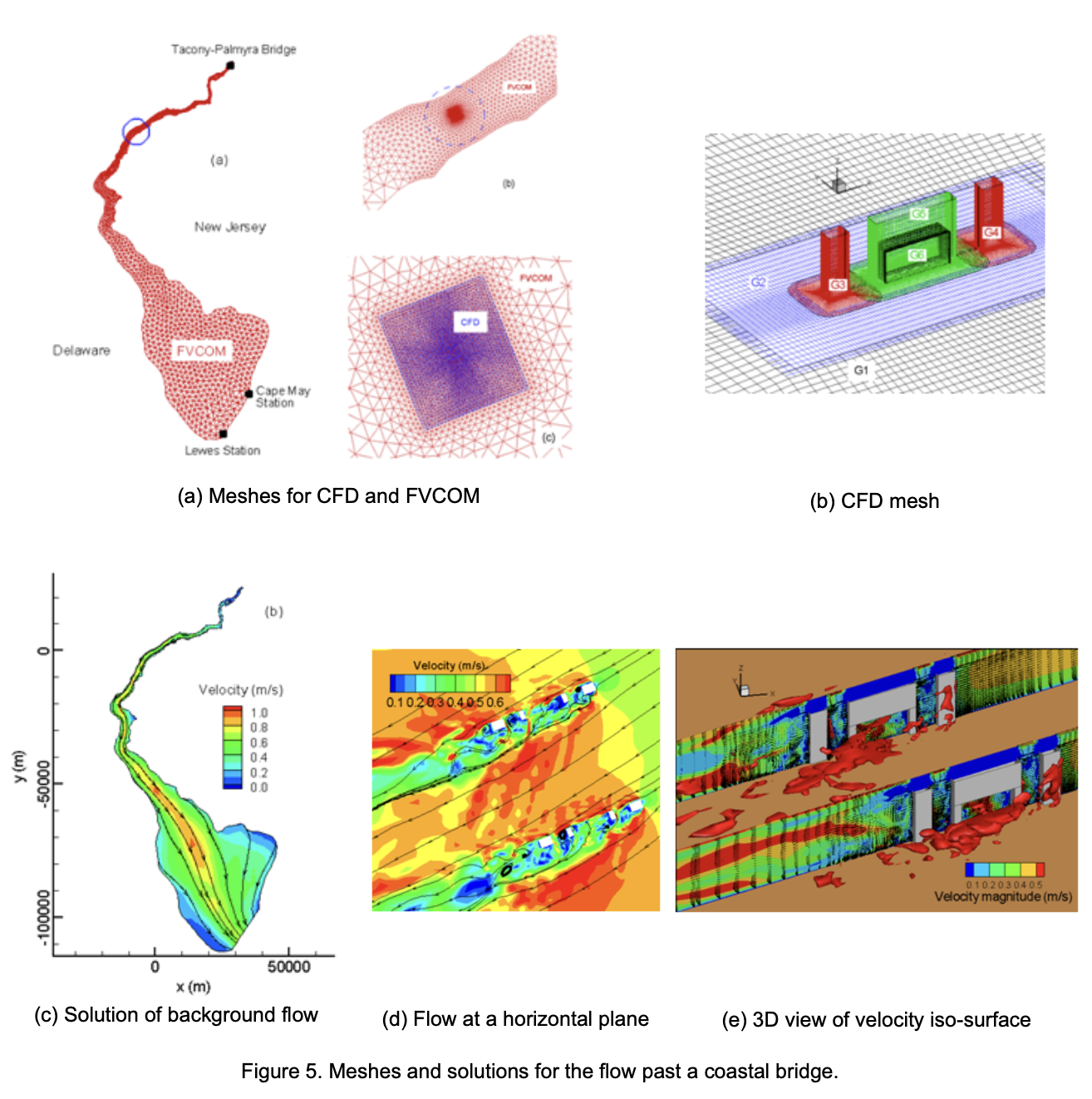
A fully 3D, unsteady, incompressible flow CFD model has been coupled with FVCOM. The CFD model uses curvilinear coordinates and overset grids, and FVCOM utilizes triangle meshes and sigma coordinates. The coupling is two-way and realized the Schwarz alternative iteration. The coupling systems targets modeling of multi-scale/multi-physics coastal ocean flows that are beyond the reach of traditional coastal ocean models. The following are a few examples modeling results obtained with this approach.
1) Flow over sill
In the modeling of a flow over a sill, as shown as follows, it is seen that on Fig. (d) and (e), that the solution of the CFD/FVCOM coupling has the features of that obtained by the CFD apporach.
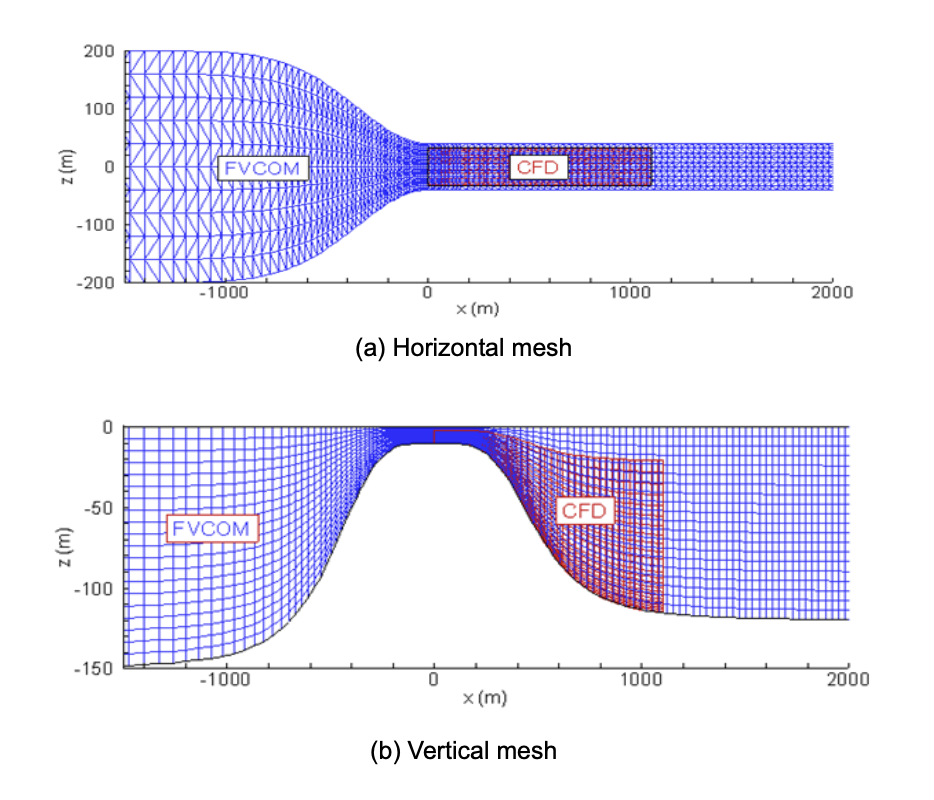
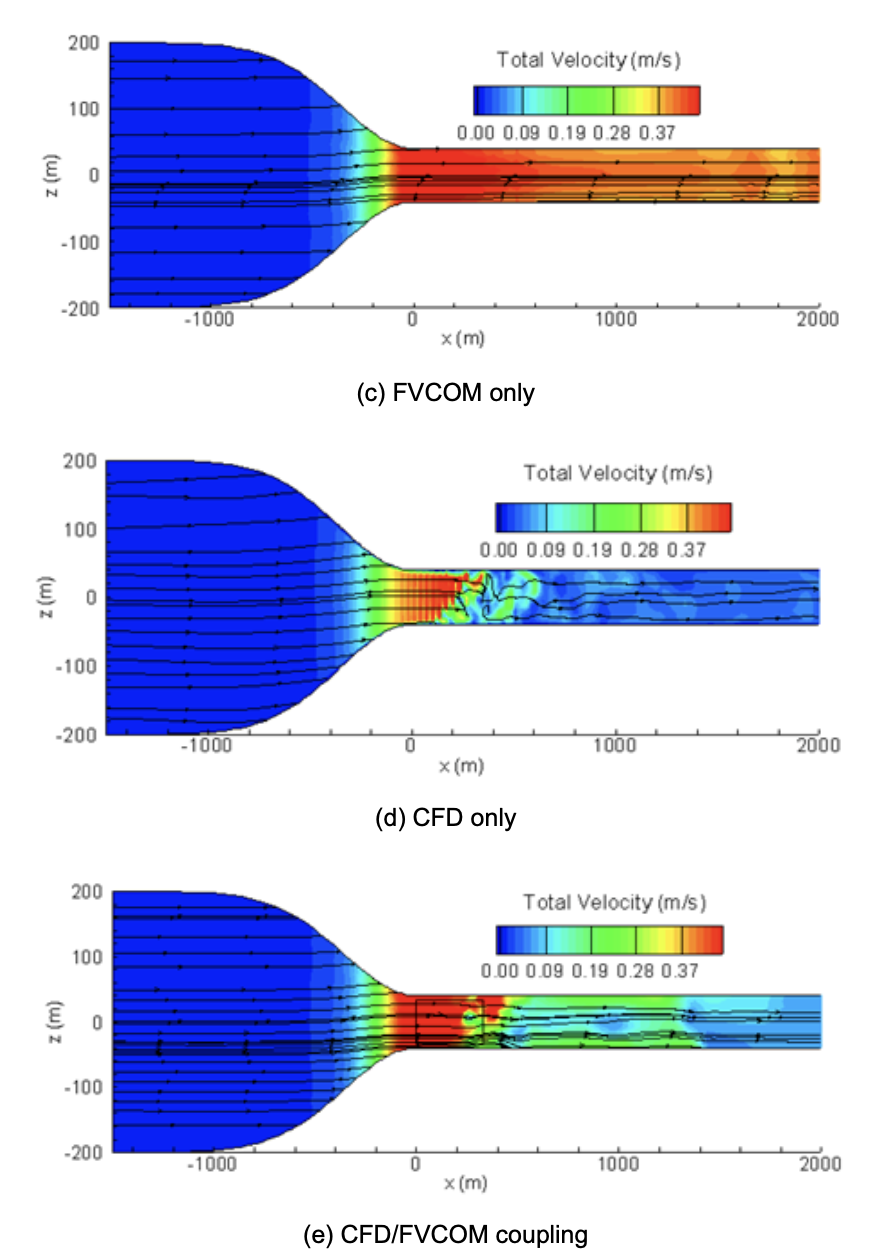
Figure 3. Meshes and solutions by FVCOM, CFD, and the CFD/FVCOM coupling. The red and blue mesh are grid of CFD and FVCOM, respectively.
2) Thermal effluent at seabed


Figure 4. Meshes and solutions for the thermal discharge at bottom of ocean
3) Flow past coastal bridge
Updates needed:
Section 2.2.g: Animation of 3d Thermal Plume needed
Last Updated: 09/25/2026 13:39