NASA EnAACT

The Enhancing Air Quality Analysis for Cities using TEMPO is a NASA-funded project to advance the capability of TEMPO. The project intends to use the geostationary satellite’s output to understand and model air quality for dense urban spaces. The project will particularly focus on PM2.5 and Ozone. The project will use field observations, urban-scale models, and AI/ML methods to enhance the TEMPO outputs.
Currently, TEMPO is mainly intended to be used at regional scales. Our goal is to extend its applicability to city and neighborhood scales where air quality is a major issue impacting health and infrastructure.
The project combines mobile field measurements of primary pollutants, high-resolution urban air quality modeling, and AI/ML-based models to understand and forecast air quality at relevant urban scales.
Under The Scorching Sun

"The climate crisis is about the Global South’s present. Not the Global North’s future.” - Disha Ravi, a Climate activist from India. This statement was echoed in a recently conducted survey on climate change perception by Yale University where the majority of Americans surveyed were worried about climate change but could not explicitly point out how it impacted their daily life. In places like South Asia, Sub-Saharan Africa, and tropical islands throughout the planet, the specter of climate change looms large in everyday life, with heat stress being the foremost risk.
Under The Scorching Sun, documents the plight of everyday workers in the Global South under the influence of extreme heat. The movie was filmed in Chennai, India in August 2023. Chennai, a major manufacturing and technology hub in India, had a population of around 5.5 million in 1991. Today the city is home to nearly 11.2 million people, growing at a rate of 2% each year over the last 2 decades (the population density is around 28,000 people per square kilometer, about the same as New York City). Most of the Indian Metropolitan areas are poorly planned and are struggling to accommodate the ballooning migrant worker population. In a battle for space, these workers often work and live in environments that are subjected to unbearable conditions. The ambient heat index during the mid-summer months in Chennai averages around 120 ˚F, and on many occasions, the wet bulb temperature reaches dangerously close to 95 ˚F - the maximum temperature that the body can regulate without shutting down.
During the shoot, the average heat index was well above 100˚F. The movie follows multiple workers who share their experiences of working in extreme heat. In addition to visaul camera, the movie was also shot using a high-definition infrared camera that exposes the body and surrounding surface temperatures.
Watch the movie at https://youtu.be/6GCJQO-1MU4
DOE Renew Natural Hazards

Heatwaves pose a grave threat to the tri-state area, where, in addition to housing, most people are dependent on electrified transportation. Currently, New York City (NYC) uses 55,000 GW-hr of electricity every year, and the peak demand is around 12,000 MW. With increased urban density, the region facilitates high heat storage in the summer months, which leads to elevated temperatures in the urban core throughout the day. The average urban heat island intensity in NYC can be as high as 5 K during a typical summer day. Climatologically, the region is influenced by the Canada High and the Bermuda High during the summer months, which could lead to stagnating systems that maintain excess heat for days to a week. In July 2016, the city experienced extreme heat for nearly three weeks. The climatology is also uniquely shaped by the coast and is heavily dependent on sea breeze/coastal winds for secondary cooling. Our previous work has shown that during heatwave episodes, the secondary cooling is lost.
Given the unique threats, the main objective of this project is to quantify the dynamic risk posed by extreme heat to housing and power infrastructure for varying future scenarios and identify and test potential solutions to mitigate the risks. The research exercise detailed here will help the trainees develop critical skills to address these urgent challenges.
DOE Climate Lighthouse

Anthropogenic climate change is increasing the frequency of extreme events in New York City (NYC), which impacts both human health and infrastructure. The city’s emergency management and planning agencies are struggling to respond to the events. The city would benefit from having high-resolution city-scale information on the rates, intensity, and spatial patterns of these extreme events. The Department of Energy (DOE) has a substantial set of weather-related observations and climate model data that provide the context for the changes and forecasts of extreme weather. However, the observations do not fully cover the city, and climate model data is too spatially coarse. In this project, we will be using high-resolution urban-scale simulations to study neighborhood-level impacts.
BEST DOE NSF CO2 Heat Pump

Major cities are rapidly evolving toward zero carbon emissions. A large portion of the emissions are related to building heating and hot water use. A deep electrification of the heating systems will be required to adavnce towards zero carbon economy. This project is a partnership with the City of New York and the HVAC industry to further develop, test, and demonstrate advanced low Global Warming Potential (GWP) electrical heat pumps for space heating and cooling and domestic hot water. We are using transcritical CO2 cycle to achieve high efficiency in heating space.
NOAA CESSRST
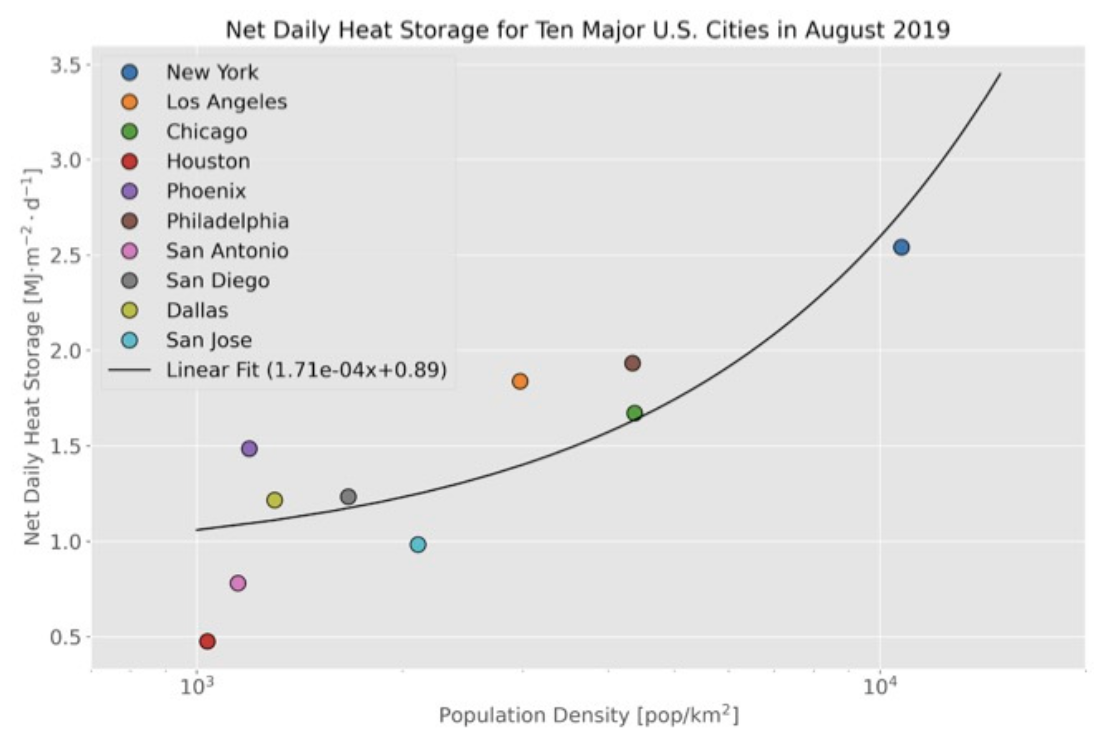
Urban remote sensing is a fledgling field. Our lab is involved in developing tools to use satellite data at meterologically relevant spatial and temporal scales.
We are currently using NOAA’ GOES 16 satellite to understand urban surface energy budget. We can now predict urban storage flux and sesnible heat flux over urban areas. Moreover it has also helped us to understand the urban radiation budget. Our models use both Artificial Intelligence and physics based algoorithms.
The products that we have developed address health and energy use in urban areas.
NSF CUBE

Our lab conducts fundamental research in to the transport of mass, momentum, and heat in the atmospheric boundary layer. We use micrometeorological principles to observe the surface-to-atmosphere interactions over complex terrains. We particularly focus on urban and coastal-urban boundary layers. The work helps us to understand and develop physics-based models to represent these complex environments. We have permanent facilities in NYC and also have the capacity to conduct these measurements anywhere required.
In this project, funded by NSF we analyzed the urban impact on convective processes in Houston, Texas. Our instrument set up included multiple sites along the coastal-urban-rural gradient to sense the surface atmosphere interactions.
Coastal-Rural-Urban Gradient:
The spectral analysis exhibits the presence of vastly different flow regimes along the coastal-rural-urban transect. The coastal site is dominated by the sea breeze effect that dictates the transport of heat and momentum. The urban and rural sites are influenced by local land cover characteristics that impact the hygro-thermal climate.
Building Energy Use
DOD ARO Urban Boundary Layer

NSF Hurricane Maria


Last Updated: 06/15/2026 19:25