
Research
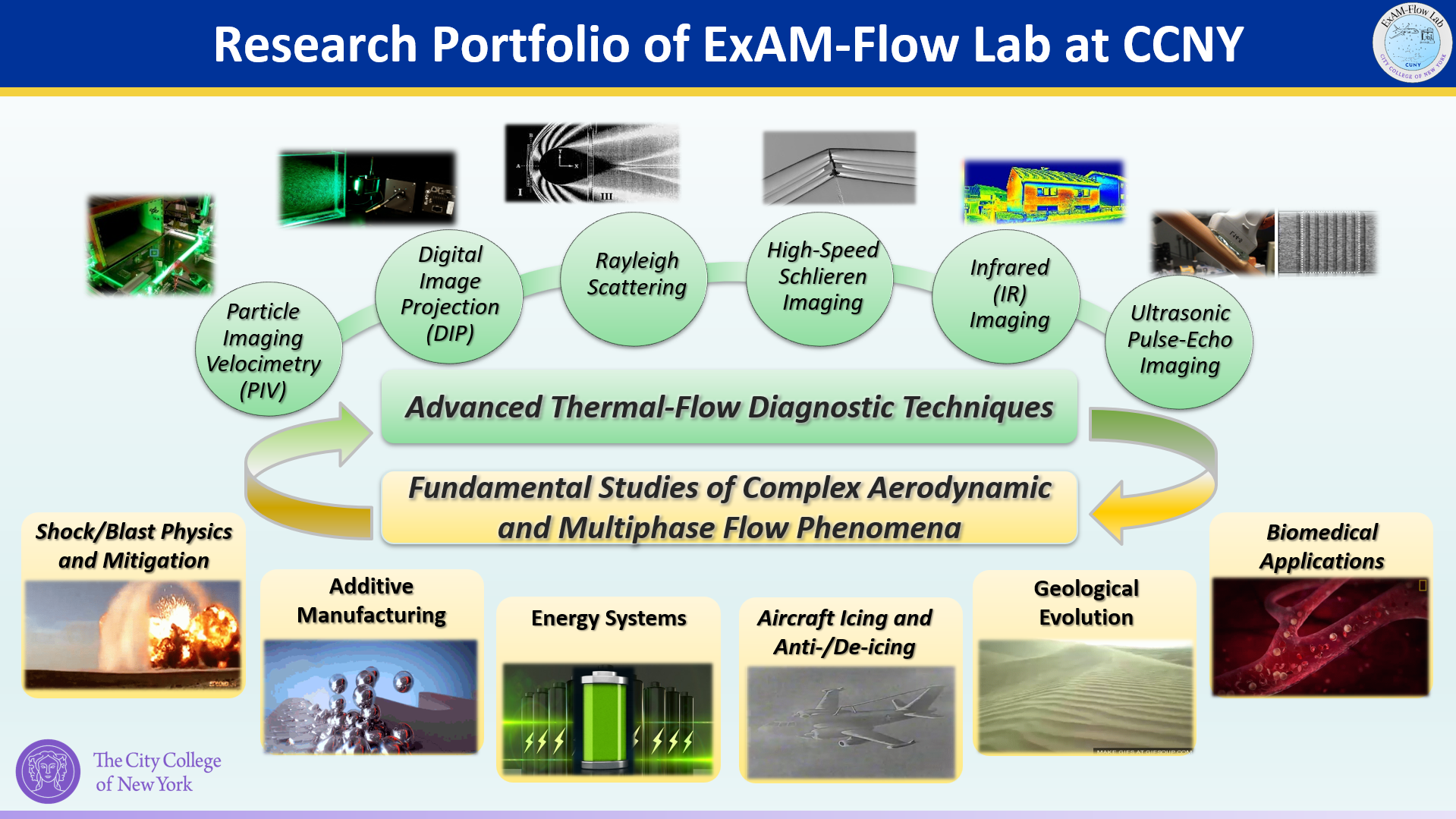
Research Areas
Research at the ExAM-Flow Laboratory centers on the experimental study of low-speed and high-speed aerodynamics and multiphase interaction involving droplets, particles, plasmas, surfaces, and various thermal flow environments. We combine carefully controlled experiments with advanced flow and thermal diagnostics to reveal the physical mechanisms governing these complex systems.
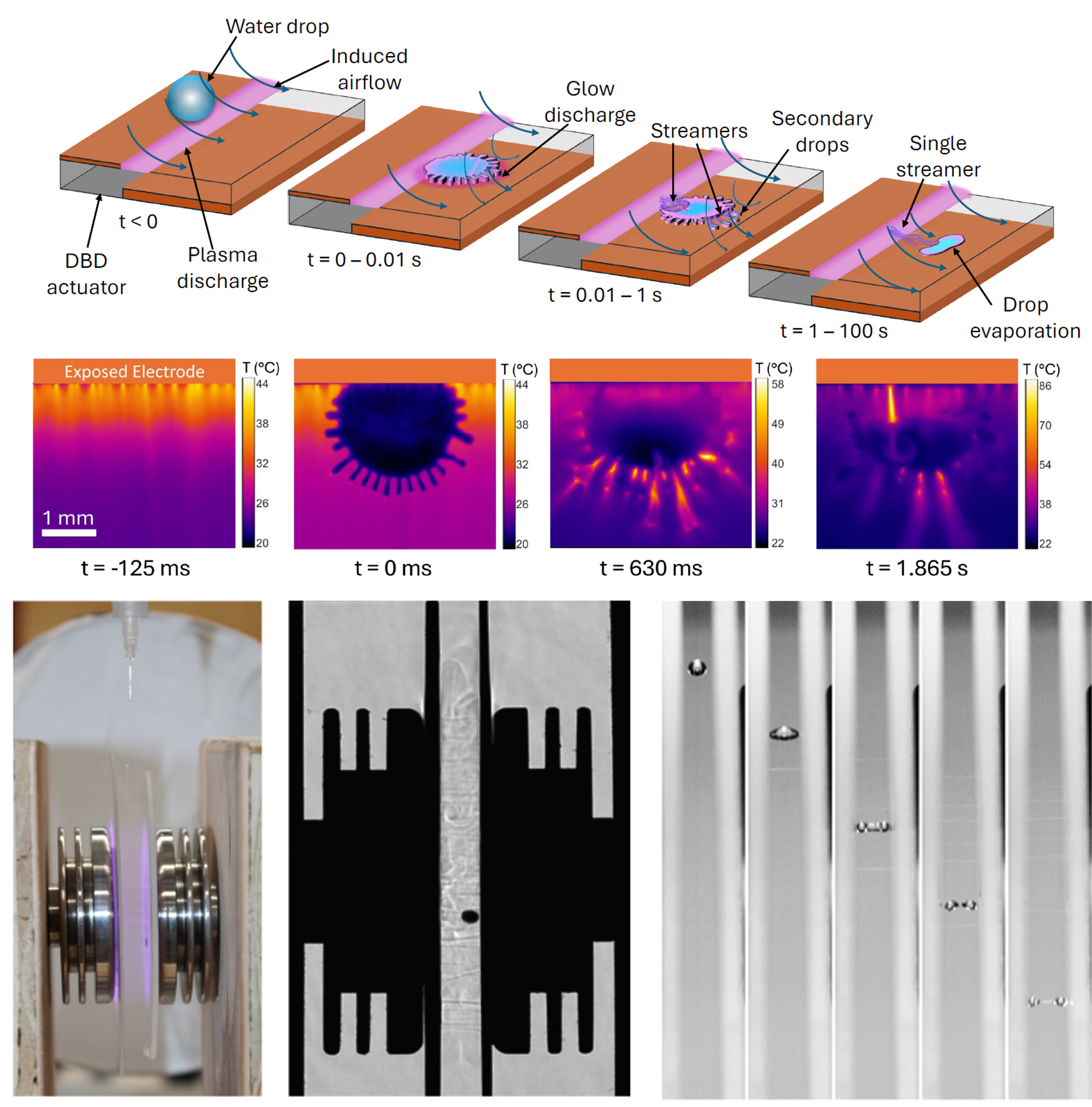
Plasma-Droplet and Plasma-Particle Interactions
We investigate how atmospheric-pressure plasma influences the motion, deformation, impact, spreading, and thermal response of droplets. Our work examines both droplets interacting with plasma in flight and droplets impacting surfaces with active plasma discharges.
We also study how plasma charging, electric fields, ionic wind, and other plasma-induced forces affect the transport and organization of particles.
Representative research directions:
- In-flight deformation and transport of droplets exposed to plasma
- Droplet impact, spreading, fingering, and heating on plasma-active surfaces
- Plasma-driven particle charging, mobilization, and reorganization
- Coupled plasma-droplet-particle transport
- Plasma-assisted surface cleaning, flow control, and anti-/de-icing
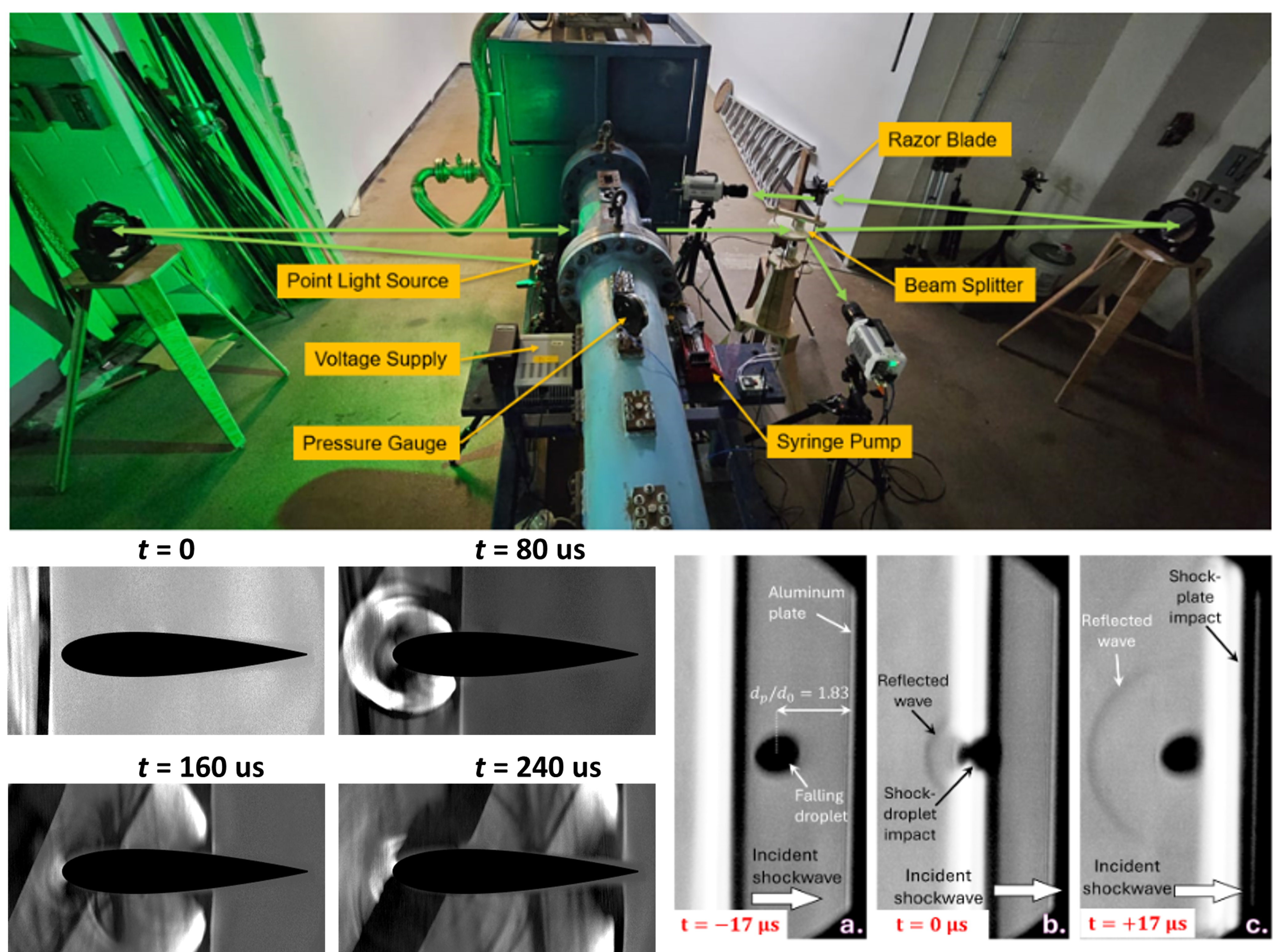
Shock-Driven Multiphase Flows
Shock waves can rapidly accelerate, deform, fragment, and disperse droplets and particles. We study these highly transient interactions to understand how momentum and energy are transferred between a shock wave and a dispersed phase.
Experiments use high-speed visualization and optical diagnostics to resolve processes that occur over extremely short timescales. The results support improved models for aerospace, propulsion, industrial safety, and other systems involving impulsive multiphase transport.
Representative research directions:
- Shock-induced droplet deformation and breakup
- Particle acceleration, dispersion, and surface interaction
- Shock interaction with particle and droplet clouds
- Transient interfacial and compressible-flow phenomena
- Transport and reorganization of particles under shock or impulsive forcing
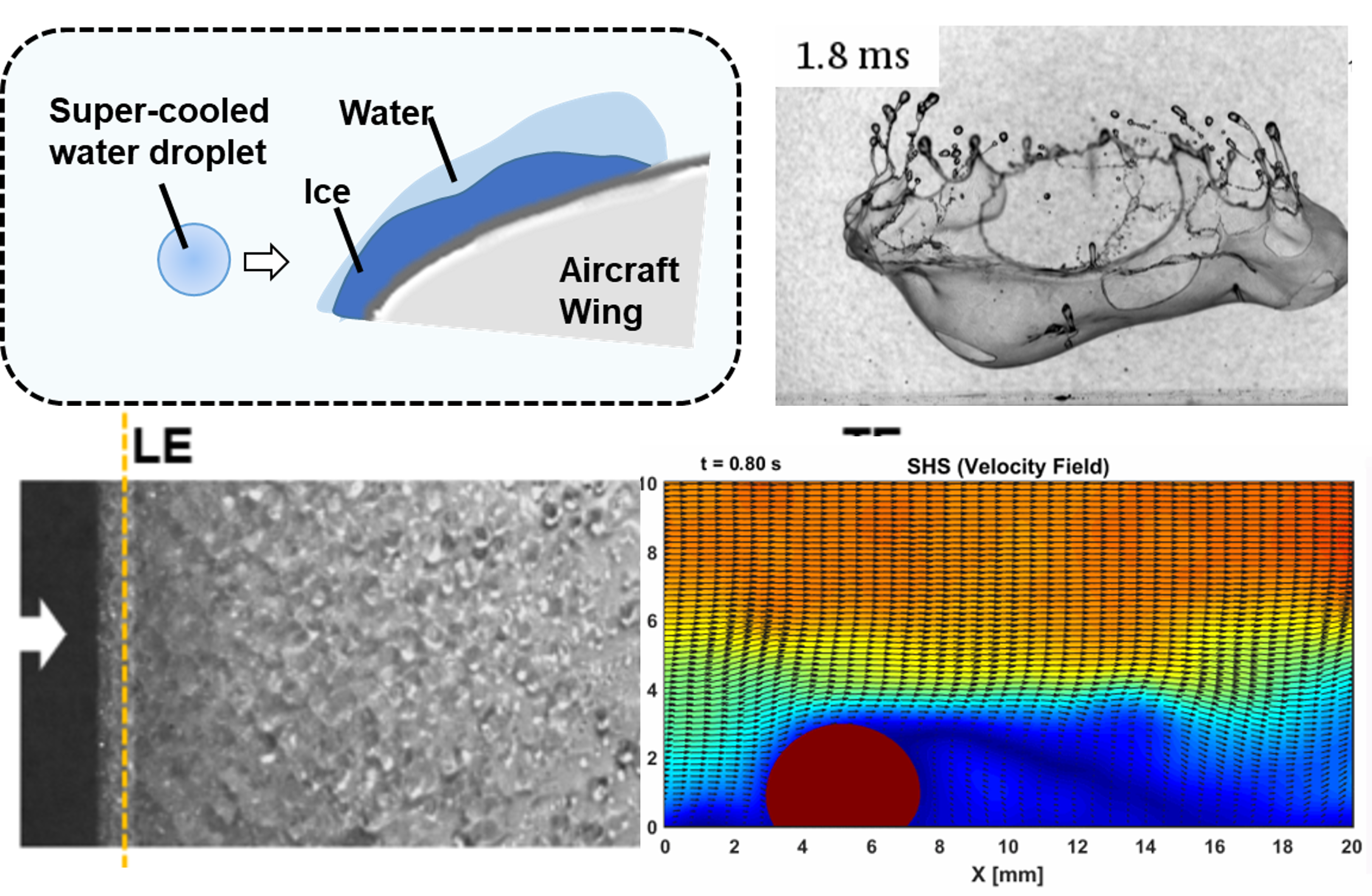
Freezing and Phase-Change Transport
We examine how droplets impact, spread, cool, freeze, and form ice on surfaces. Particular attention is given to the coupled effects of surface properties, inclination, droplet composition, airflow, and environmental conditions.
Our research also explores active and passive approaches for delaying ice formation, reducing ice adhesion, and removing accumulated ice. This work contributes to safer and more efficient aerospace, wind-energy, transportation, and thermal systems.
Representative research directions:
- Impact and freezing of water and colloidal droplets
- Ice nucleation, propagation, and accretion
- Droplet freezing on inclined and engineered surfaces
- Coupled heat transfer, wetting, and phase change
- Plasma-based, biological, and surface-based anti-/de-icing approaches
Multiphase Additive Manufacturing
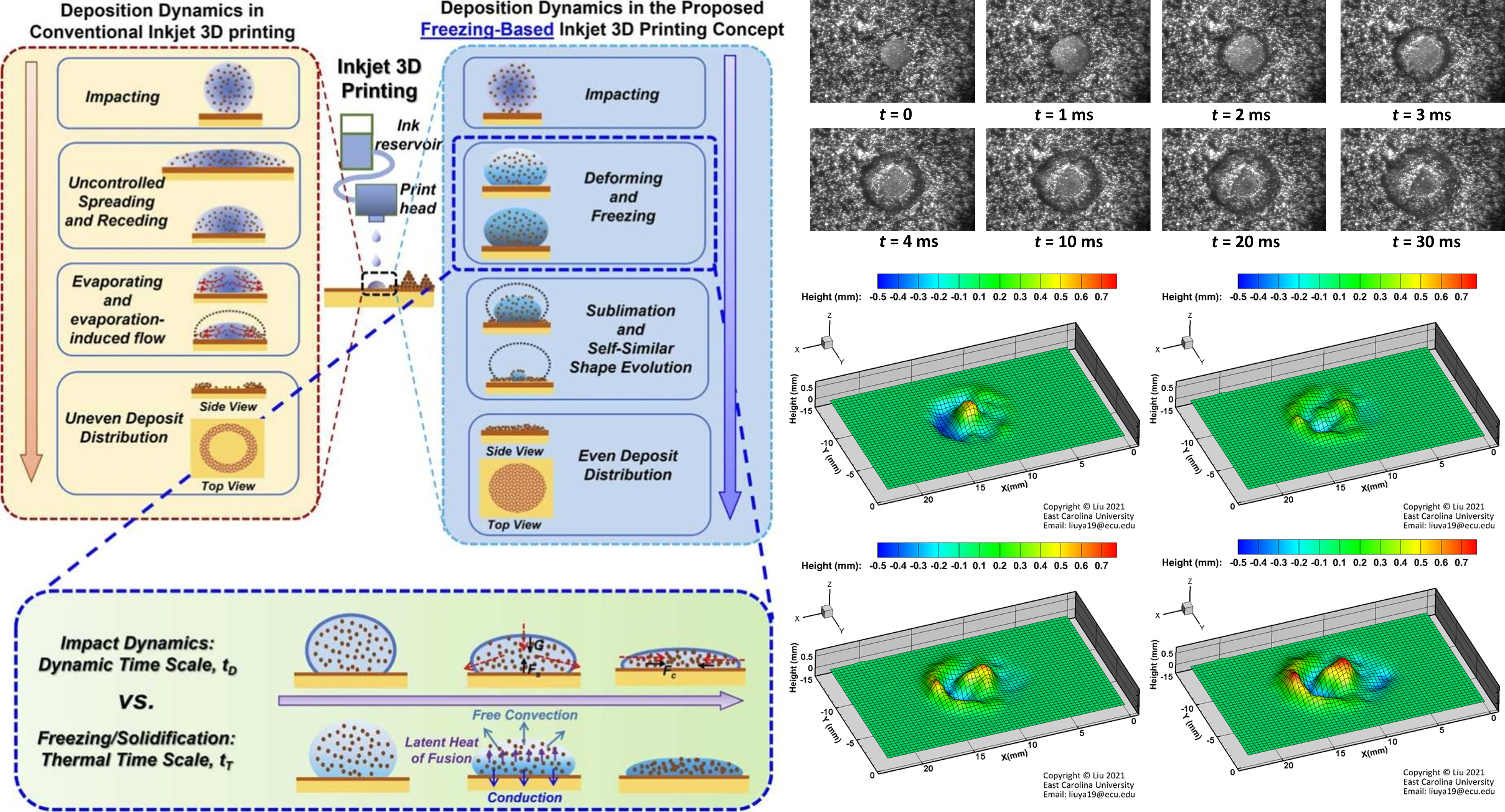
Droplet-based manufacturing involves complex interactions among fluid flow, particle transport, heat transfer, solidification, and material deposition. We investigate these processes to understand how individual droplets and suspended particles determine the structure and quality of printed materials.
A major focus is freezing-assisted inkjet printing, in which deposited droplets are solidified to control their shape and placement. Subsequent phase-change processes can then be used to produce organized particle structures and functional materials.
Representative research directions:
- Deposition and solidification of colloidal droplets
- Freezing-assisted inkjet and droplet-based printing
- Particle redistribution during evaporation, freezing, and sublimation
- Interactions between deposited droplets and particulate surfaces
- Control of printed geometry, porosity, and material microstructure
Experimental Aerodynamics and Advanced Diagnostics
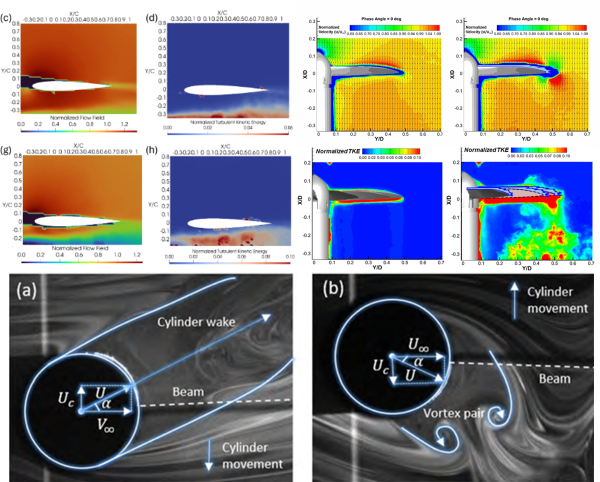
We study fundamental and applied aerodynamic flows involving airfoils, bluff bodies, wakes, vortices, separated flows, and unsteady fluid–structure interactions. These experiments help reveal how flow structures develop and how they affect aerodynamic forces, performance, and stability.
Advanced measurement techniques allow us to observe flow and thermal phenomena that cannot be adequately described using conventional measurements alone.
Representative research directions:
- Airfoil aerodynamics and separated flows
- Wake dynamics and vortex formation
- Unsteady flow and fluid–structure interaction
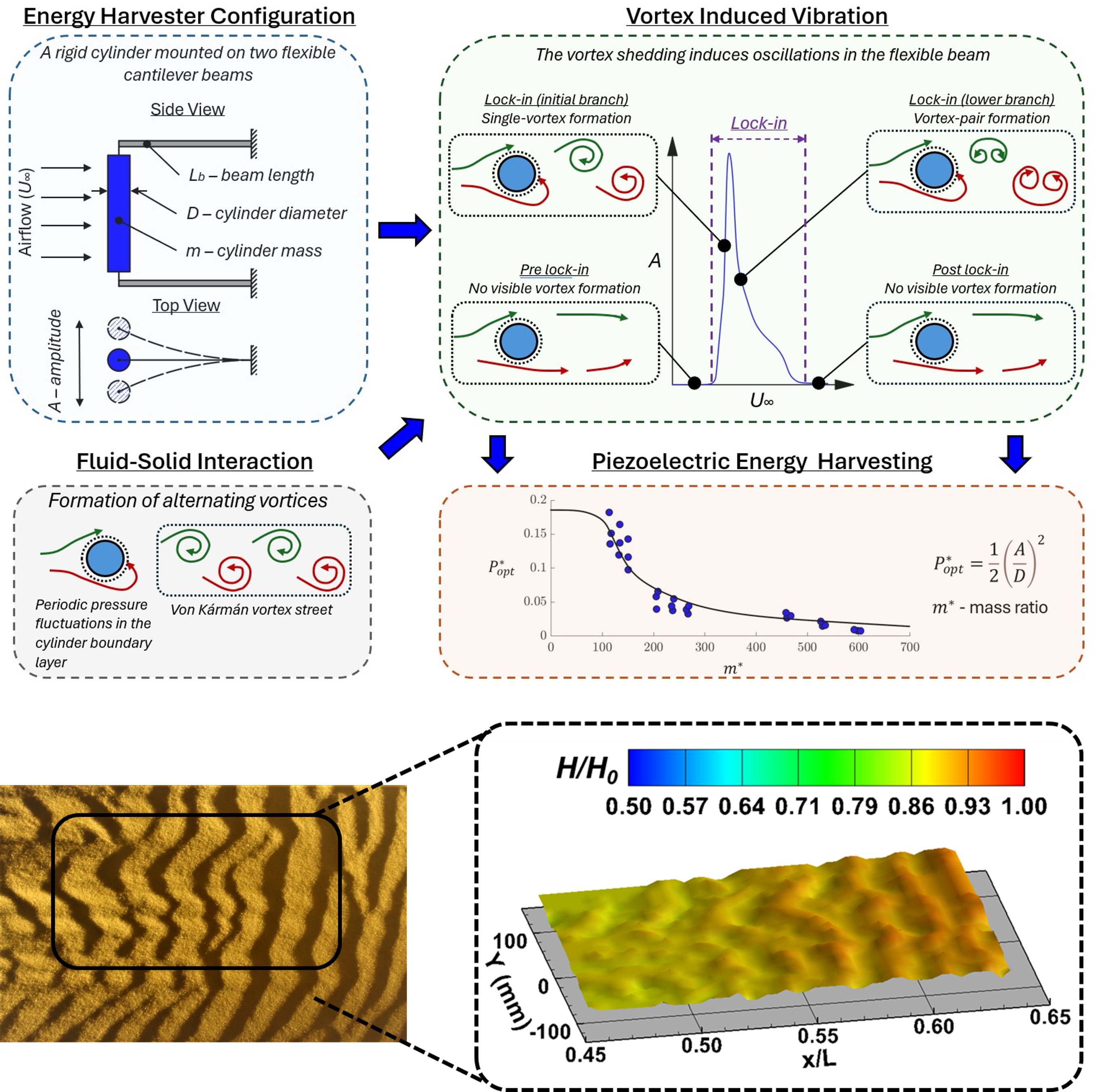
- Vortex-induced vibration and flow-energy harvesting
- Development and application of advanced experimental diagnostics
Energy and Environmental Flow Systems
We apply fluid mechanics, multiphase transport, and heat-transfer principles to challenges in energy production, environmental protection, and the built environment. The goal is to connect fundamental research with technologies that improve efficiency, safety, and sustainability.
Current interests include wind-energy flows, spray and icing processes, energy harvesting, airborne-particle control, and plasma-assisted environmental technologies.
Representative research directions:
- Wind-turbine aerodynamics, spray interaction, and icing
- Vortex-induced vibration for energy harvesting
- Plasma-assisted spray filtration and particulate capture
- Airborne particulate matter and carbon-dioxide control
- Emissions and transport processes associated with additive manufacturing
- Thermal-fluid systems for buildings and environmental control
Funded Research Projects
ExAM-Flow research has been supported by federal agencies and CUNY programs. These projects advance fundamental discovery, experimental capabilities, student training, interdisciplinary collaboration, and the translation of research into practical technologies.
- I-Corps: Translation Potential of an Advanced Air Filtration System that Captures Particulate Matter and Carbon Dioxide, National Science Foundation (NSF) I-Corps™, Award # 2525250, PI, 2025-2027.
- GOALI/Collaborative Research: Nonlinear Energy Dynamics of Aerodynamically Coupled Oscillators, National Science Foundation (NSF) DCSD, award # 2131600, Co-PI, 2021-2026.
- ERI: Understanding the Dynamic and Thermal Behaviors of Colloidal Droplets Toward a Novel Freezing-based Inkjet Additive Manufacturing Concept, National Science Foundation (NSF) CBET, award # 2138214, PI, 2022-2025.

- Fundamental Study of the Dynamic and Thermal Behaviors of Supercooled Droplet Interacting with Plasma Discharge, Department of Energy (DOE) Research in Basic Plasma Science and Engineering Program, PI, 2023-2026.

- A Fundamental Study of the Anti-Icing Mechanisms of a Bacteria-Spores-based coating in Mitigating Dynamic Droplet Impinging and Freezing, Translational Research Excellence Across Disciplines (TREAD) program, The City College of new York, PI, 2025-2029.

- Development of a Bio-Inspired Bacteria-Spores-based Anti-/De-Icing Surface, The Advanced Science Research Center (ASRC) Collaborative Seed Grant Program, PI, 2024-2026.

- An Ultrafast, Intensified Camera System for Time-resolved Imaging and Spectroscopy, GRTI Round 26, PI, 2026-2027.
- Development of a High-Energy Stereo Laser-Optic Thermal-Flow Diagnostic System, GRTI Round 24, PI, 2023-2024.
- Investigation of Droplet Evaporation and CO2 Capture Efficiency in a Spray-based Direct Carbon Capture Technology, The City College Initiative to Promote Academic Success in STEM (CiPASS) Program at CCNY, PI, 2024-2025.
- Investigation of supercooled droplet impact dynamics interacting with plasma discharge, The City College Initiative to Promote Academic Success in STEM (CiPASS) Program at CCNY, PI, 2023-2024.
- Investigation of Supercooled Droplet Impinging and Freezing Dynamics on a Novel Durable Non-Textured All-Solid Slippery Surface, PSC-CUNY Research Award Program, PI, 2023-2024.
- A Fundamental Study on the Hydrodynamics and Transport Behaviors of Droplet Impinging on a Multilayer Porous Surface, PSC-CUNY Research Award Program, PI, 2026-2027.


Last Updated: 09/03/2026 12:05