Kylee Pastore Asirvatham
There is a moment Liz Wolfe still remembers from the end-of-semester MUS 115 concert at Silvana in East Harlem. Her band started playing “Wonderwall,” and suddenly the room joined in. “There were so many supportive friends and family members cheering us on in the audience,” Wolfe remembers. “And when we played our song ‘Wonderwall’ everyone in the venue sang right along with us.”
Arms went up. Voices got louder. Wolfe looked out at the crowd and realized that what had begun months earlier as a City College class had, for a few minutes, turned into something else entirely. “It was a true ‘rock and roll concert’ moment,” she says, “completely unexpected and so heartwarming.”
That possibility is at the center of MUS 11500: Performing Popular Music, a rotating-topics course taught by Professor Matt Carter. Students don’t simply study popular music in MUS 115. They form bands, choose repertoire, rehearse together, arrange and reinterpret songs, compose original music, and eventually perform it in front of an audience. And sometimes the bands keep going after the semester ends.
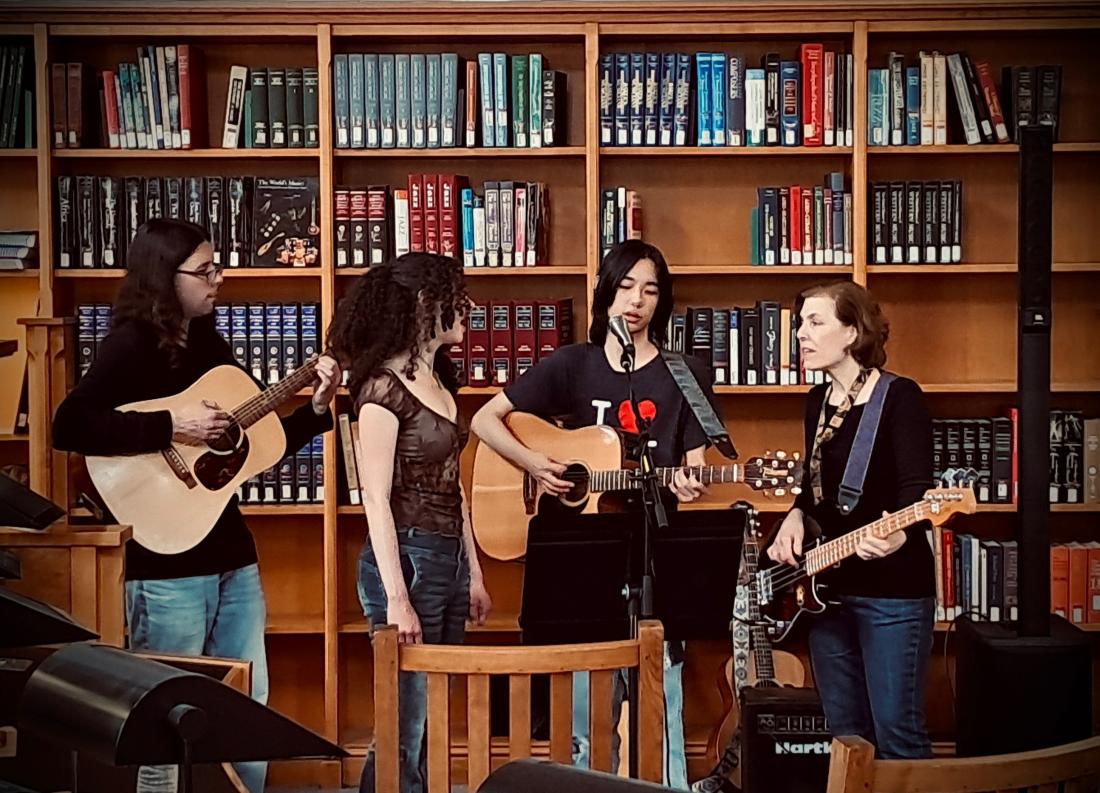
Wolfe met Mike O'Donnell, Daniel Kim, and Margaux Flum through the course. Together, they became the City College Pickers, a bluegrass band that continued playing after MUS 115 ended. The group has since performed at the City College library and at Mary O's in the East Village, and they plan to reunite this fall to learn new material and perform again.
For Wolfe, one of the most valuable parts of the course was learning how to become a band rather than simply a collection of musicians. “It meant learning to listen to and trust one another, and be willing to adjust for the benefit of the band, even if it wasn't our personal preference,” she says. But there was something simpler at work, too. “I just really loved getting together to play music with one another in a classroom setting, which gave us guidance and purpose to our playing.” That mixture—structure without losing the pleasure of simply making music together—is intentional.
MUS 115 typically comprises two or three student bands. Instrumentalists, vocalists, rappers, and producers are welcome, and students do not need to be music majors. Because the course depends on creating functional bands, however, instructor permission is required. Students should already have some proficiency with their instrument or voice, though the point is not to arrive as a finished musician.
The point is to have somewhere to go next. “The bands learn how to pick repertoire, organize a setlist, structure rehearsals, create new music with others, and build lasting personal and even professional relationships,” Professor Carter says. The experience can also introduce students to musicians and venues beyond campus. He has already seen two groups continue gigging regularly after meeting in the class.
Each semester gives students a new musical problem to solve. This Fall 2026, MUS 115 is moving through the history of American popular music while concentrating on modern interpretations of “oldies” pop songs from the 1940s and ’50s. Students analyze the music's conventions, experiment with ways to update it, and then use what they discover to create something of their own. Each band composes an original song, and the semester culminates in live performances—including an off-campus show.
For a student looking at the Spring 2027 schedule and wondering whether to ask for permission to enroll, the City College Pickers offer one answer to what can happen in MUS 115.
You might sign up for a class. You might leave with a band.
**Photo: The City College Pickers are Liz Wolfe (vocals, guitar, bass, ukulele), Mike O'Donnell (vocals, guitar, mandolin), Daniel Kim (vocals, bass, guitar), and Margaux Flum (vocals).