Sophie Torres
In her first article, Sophie Torres took us inside the uncertainty, urgency, and small victories of landing an internship, demystifying a process that often feels out of reach for students navigating it for the first time. Now, in the second installment of this three-part series, she shifts from getting in the door to what it actually means to be there.
At PEN America, Sophie’s work quickly revealed a side of publishing that is rarely seen from the outside. What began as an opportunity to build professional experience became an encounter with the fragile, complicated systems that shape how stories move, and sometimes stall, in the world. This next chapter of her journey offers a closer look at the realities of the internship itself: the rhythms, the obstacles, and the unexpected moments that define what it means to participate in a literary ecosystem.
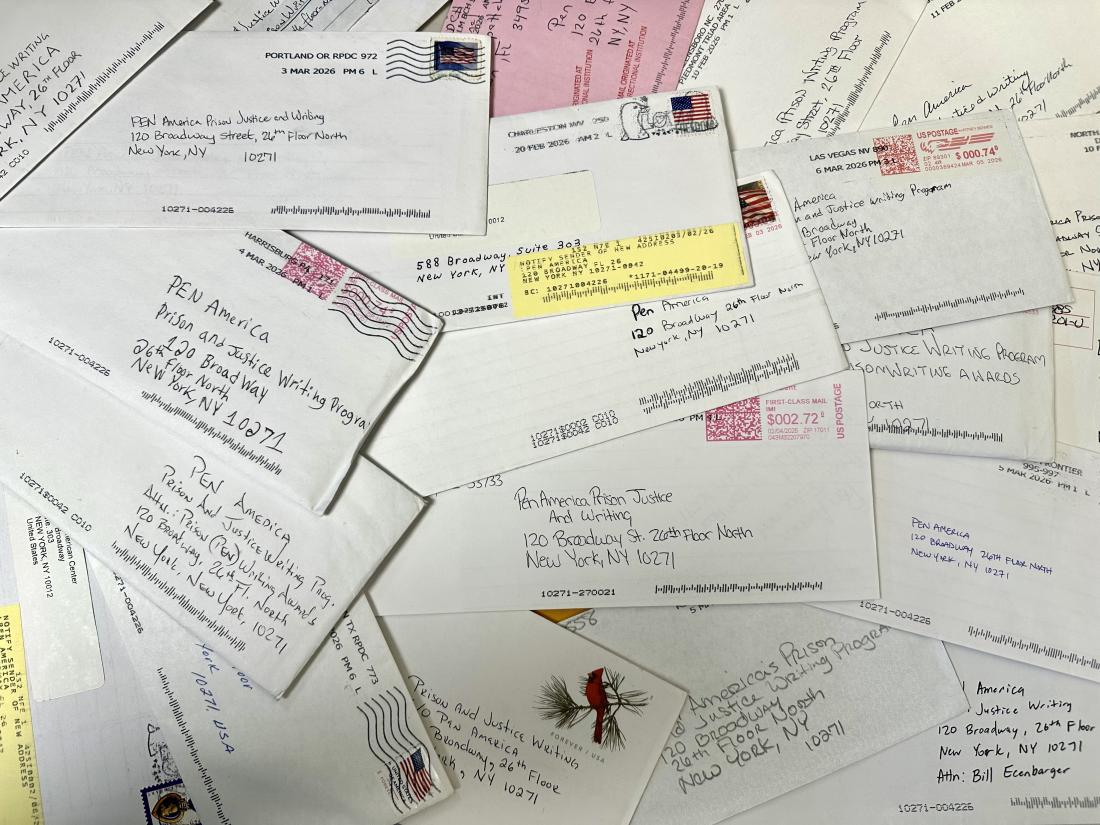
For the nearly two million people currently incarcerated in the US, physical mail is the only connection to the outside world. While for us the world keeps spinning and moving daily, for them, days awaiting correspondence can be long, grueling, and disheartening. When I began my internship at PEN America, I had no idea about the nuances that go into working with incarcerated writers. The Prison and Justice Writing Program at PEN was founded in the wake of the Attica prison riots and has been operating for over 50 years. They offer several different initiatives, the main ones being the PEN Prison Writing Awards and PEN Prison Writing Mentorship Program (Prison and Justice Writing Program, or PJW). The majority of award submissions and mentorship communications come through the mail: in 2024, the PJW received over 1,200 handwritten submissions for awards. The majority of my work with PJW involves reading and responding to correspondence sent from incarcerated individuals. This means I am primarily working with "snail mail."
Physical mail is the most common form of communication for incarcerated people. However, this system has a multitude of drawbacks; pieces of mail may be damaged in the shipping process, confiscated, or can even be lost entirely. Barring these complications, mail can still take weeks or months to reach its final destination. Most writers send original copies of their work, which can be risky. Every day, prisons and jails across the US are changing their rules and regulations regarding physical mail correspondence. On my first day at PEN America, I was given a postal mail protocol document: a six-page guide chronicling the updated requirements that US state and federal facilities have set for physical mail. These requirements range from the number of pages allowed in one envelope, to the type of pen that can be used, to the color, size, and material of the paper or envelopes permitted inside. On top of physical rules and regulations, the process of sending physical mail is often slowed by the US Postal Service or impeded by correctional officers, who have been known to read, censor, or even plant contraband in incoming letters.
Every day that I approach my desk at the PEN America offices, I take a moment to observe the tower of new incoming letters, which grows daily. Between stacks of handwritten submissions and general inquiries about the program are dozens of return-to-sender envelopes. This was one of the facts I was most surprised to learn while on the job; the majority of letters you send may be sent right back to you, and not always immediately. Often, when mail is returned, the reason is not marked on the envelope, leaving it up to us to troubleshoot. Some of the most common reasons are that an individual has been transferred, released, or paroled. If none of these apply, the most likely explanation is that new rules and regulations have been put in place for that distinct facility or institution.
Aside from mail being returned, it is often delivered damaged or in a tattered condition. My supervisor, Jess Abolafia, once told me about a time a piece of mail was delivered to her, ripped clean in half. The entire envelope, including its contents, had been torn right down the center, placed in a USPS plastic bag with large letters stating, “WE CARE” plastered across the front; the juxtaposition was not lost on her. Letters also frequently arrive with evidence of censorship from correctional officers: dark black sharpie ink striking through pertinent information, such as the sender's name or address, which is often covered by large red Department of Corrections stickers.
On top of physical censorship, many facilities and institutions have switched to a paperless mail system. These select facilities—of which there are dozens—are now scanning and digitizing mail at increased rates in an attempt to reduce contraband, specifically drugs, from entering prisons nationwide. However, there is no evidence to support claims that mail digitization mitigates the risk of contraband entering prison walls, mainly because such contraband is frequently brought in through correctional officers themselves.
When sending mail to institutions that have adopted a digitized system, it must be sent to a scanning facility rather than the individual directly. For example, any correspondence sent to facilities in Pennsylvania must first be sent to Saint Petersburg, Florida, where it will be scanned and subsequently uploaded. This further delays shipping; something that may have taken two weeks may now take two months. In addition to delays, this digitization process can add to the feeling of dehumanization that incarcerated people feel on a daily basis. A lot of times, scanned correspondence is uploaded blurry or with certain things cut out, making it unreadable and taking away the personal feeling of holding in your hands the same piece of paper someone else has touched.
These challenging circumstances have led many incarcerated individuals to change their preferred correspondence to prison email platforms, such as JPay, Securus, and Getting Out. These platforms help cultivate a more efficient mode of communication; however, there are still many restrictions like limited character and word count, no formatting, and a limited number of photos one can send. They are also on a pay-per-message basis, and many of these platforms can be financially exploitative. Not to mention, these messages are more likely to be heavily monitored and censored than physical mail.
In my short time with the Prison and Justice Writing Program at PEN America, I have witnessed the complex dynamics of postal protocols and the digital barriers that incarcerated individuals and their supporters face on a daily basis. The biggest thing I have come to learn has been that the carceral system often prioritizes administrative control over the preservation of the human spirit. Yet, despite these barriers, I have also witnessed the unyielding resilience, empathy, and faith present in every handwritten letter that lands on my desk. My time in the Prison and Justice Writing Program has shown me that while a stamp or a scan may seem trivial to those of us in a world that keeps spinning, for those within, it is a vital lifeline—a reminder that their stories have value and that, despite the miles of red tape, someone is still listening on the other side.